

We like to think of ourselves as rational when making important decisions.
We gather information, weigh the pros and cons, and convince ourselves that we’ve made the best possible choice.
Behavioral psychology tells a different story.
People rarely approach every new situation with complete objectivity. More often, we interpret the present through patterns of thought shaped by past experiences, and then make decisions that fit those patterns.
The decision may seem new. The thinking behind it usually isn’t.
Someone who has been betrayed finds it difficult to trust again.
Someone who grew up in financial hardship may still feel anxious about spending money, even after becoming financially secure.
Someone who once succeeded by taking risks is more likely to embrace uncertainty whenever a new opportunity appears.
Conversely, someone who has experienced a painful failure may hesitate, even when presented with an objectively attractive opportunity.
On the surface, these look like entirely different decisions.
Psychologically, however, they’re often the same pattern repeating itself.
Our brains aren’t always asking the question we think they are.
We assume we’re asking,
“What’s the best decision I can make right now?”
But more often, the brain is asking something else:
“What choice kept me safe the last time I faced a situation like this?”
Those are not the same question.
The safest decision isn’t always the best one. Yet the human brain evolved for survival, not optimization.
When faced with uncertainty, it naturally favors what’s familiar over what’s objectively optimal.
Behavioral psychology explains this through reinforcement learning.
When a particular behavior produces a positive outcome, the brain stores it as a rule.
“Taking risks worked.”
Eventually, that becomes:
“Success comes from being bold.”
Conversely, if taking on a new challenge once ended in failure, the lesson may become:
“Taking risks are dangerous.”
The problem is that these rules don’t automatically adapt as the world changes. Markets change. People change. Circumstances change. But our patterns of thinking often don’t.
This is where heuristics come into play. Heuristics are mental shortcuts the brain uses to solve complex problems quickly. Rather than analyzing every situation from scratch, we reuse decision-making strategies that proved effective in the past. That makes decisions faster. But when the environment changes, those same shortcuts can become sources of bias.
And once a pattern is established, we tend to reinforce it.
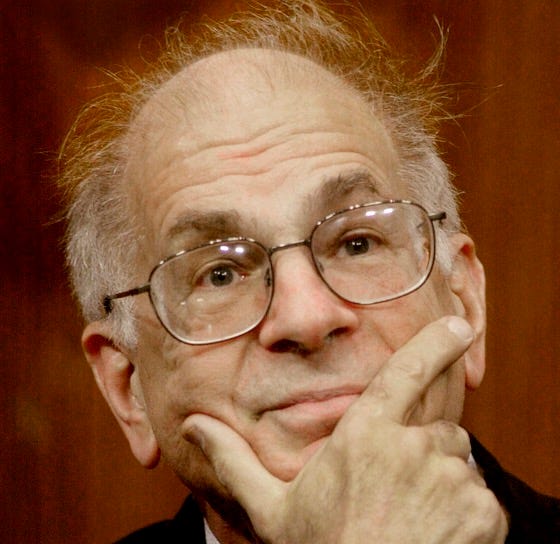
As Daniel Kahneman and Amos Tversky demonstrated, people are naturally inclined to preserve their existing beliefs rather than evaluate every new piece of information objectively.
This tendency is known as confirmation bias.
Once someone begins to believe,
“I’m naturally a cautious person,”
they’re more likely to remember the times caution protected them than the times courage paid off.
Likewise, someone who believes,
“Opportunities belong to those who act boldly,”
is more likely to remember their successes while dismissing failures as mere bad luck.
In other words, we don’t simply observe reality. We interpret reality in ways that preserve the patterns we’ve already built.
Investing makes this psychology especially visible.
Most investors say that value matters more than price. But their behavior often suggests otherwise. Assets that have risen sharply feel expensive. Assets that have fallen significantly feel cheap.
Yet price and value are not the same thing.
A $100 asset is cheap if it’s worth $500.
A $10 asset is expensive if it’s worth only $1.
Still, people tend to trust the decision-making patterns they’ve repeated for years more than the intrinsic value in front of them. That’s why the best decision makers aren’t necessarily the people with the most information. They’re the ones most willing to question their own patterns of thinking.
The most important question isn’t,
“Is this the right decision?”
It’s this:
“Am I responding to reality, or am I simply repeating a pattern from my past?”
Growth isn’t about accumulating more knowledge.
It’s about recognizing the mental patterns that once protected you but now hold you back. People don’t change because they receive new information. They change because they develop new ways of thinking. The same principle applies to investing, careers, relationships, and life itself.
The greatest obstacle isn’t the market. It isn’t the economy. It isn’t the people around us.
The force that shapes our decisions most consistently is the pattern of thought we’ve repeated for years.
Because in the end,
We don’t respond to reality. We respond to our interpretation of reality.
And that interpretation is often nothing more than a pattern written by our past.
References
Kahneman, D. (2011). Thinking, Fast and Slow.
Tversky, A., & Kahneman, D. (1974). Judgment Under Uncertainty: Heuristics and Biases. Science.
Kahneman, D., & Tversky, A. (1979). Prospect Theory: An Analysis of Decision under Risk. Econometrica.
Skinner, B. F. (1953). Science and Human Behavior.
We all think in invisible patterns, and thats what results in decisions out of our control. We can only really control the decisions we consciously know we’re making.